Wine Sweetness Chart
Is Riesling sweet? Is Prosecco “Extra Dry” drier than Brut? Wine sweetness depends on how much natural grape sugar is left after fermentation — and on acidity, which can make a sweet wine taste balanced. This chart places popular wines on a dry-to-sweet scale and explains the label terms, with a converter to place any residual sugar figure on the scale.
- Instant download
- Editable Excel & Word
- Print-ready PDF
- 7-day refund
10 resource files + README (11 files total) · PDF, XLSX, DOCX
Wine Sweetness Chart Pack
Six free PDFs plus three editable Excel files and one Word notes sheet in a single optional $5 ZIP. Includes sweetness references and a cellar log with count validation.
- Sweetness chart (PDF)
- Sparkling labels (PDF)
- Residual sugar table (PDF/XLSX)
- + 3 more
$5.00 USD, one-time 10 resource files + README (11 files total)
- Instant download
- 7-day refund
- Secure checkout by Stripe
7-day money-back guarantee. Full refund within 7 days of purchase, even after you download.
Free sample: Wine Sweetness Chart (PDF, 78 KB)
Wine Sweetness Chart Pack
Six free PDFs plus three editable Excel files and one Word notes sheet in a single optional $5 ZIP. Includes sweetness references and a cellar log with count validation.
- Sweetness chart (PDF)
- Sparkling labels (PDF)
- Residual sugar table (PDF/XLSX)
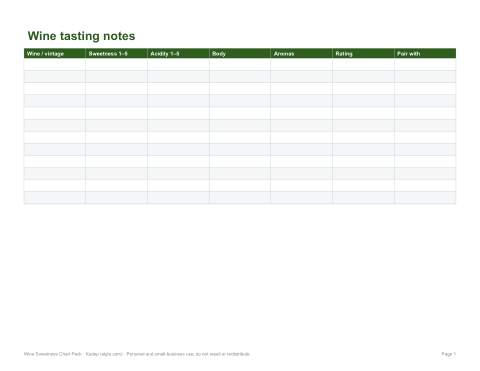
- Tasting notes (PDF/DOCX/XLSX)
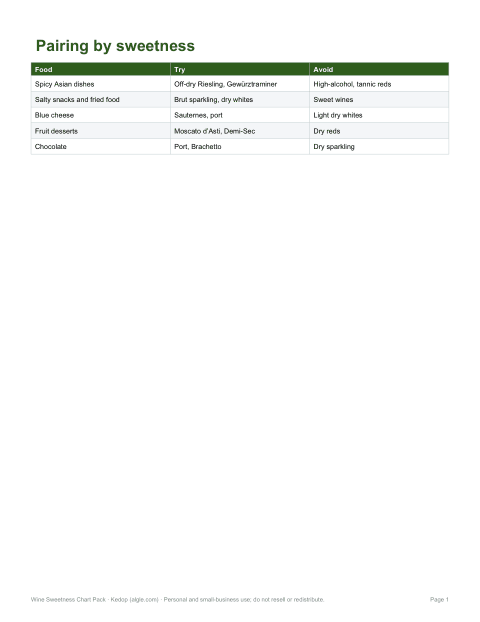
- Pairing guide (PDF)
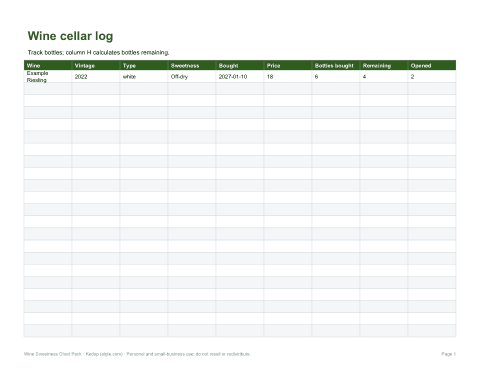
- Cellar log (PDF/XLSX)
Formats: PDF, XLSX, DOCX. Instant download after payment (link valid 72 hours, up to 5 downloads). AI-assisted: the templates were drafted with AI help and reviewed and laid out before publishing.
$5.00 USD, one-time 10 resource files + README (11 files total)
- Instant download
- 7-day refund
- Secure checkout by Stripe
7-day money-back guarantee. Full refund within 7 days of purchase, even after you download.
Free sample: Wine Sweetness Chart (PDF, 78 KB)
Full refund within 7 days — see the refund policy and license.
Free printables
Single sheets you can print right now, no sign-up. The full pack adds every sheet in one download plus the editable files.
 Printable Wine Sweetness Chart2 pages · free PDF
 Printable Sparkling Wine Sweetness Chart1 page · free PDF
 Printable Residual Sugar Table1 page · free PDF
 Printable Wine Tasting Notes Sheet1 page · free PDF
 Printable Wine Sweetness Pairing Chart1 page · free PDF
 Printable Wine Cellar Log3 pages · free PDF
Use the wine sweetness chart
What’s in the pack
- Printable wine sweetness chart (dry to very sweet) for whites, reds, rosés, sparkling, fortified and dessert wines
- Sparkling wine sweetness labels chart (Brut Nature to Doux)
- Residual sugar reference table with sugar per glass
- Wine tasting notes sheet
- Food and wine sweetness pairing guide
- Wine cellar log spreadsheet
All six PDFs are free individually. The optional $5 ZIP adds three Excel files and one Word notes sheet. It contains 10 resource files plus README (11 files total). PDFs are US Letter; use fit to page on A4.
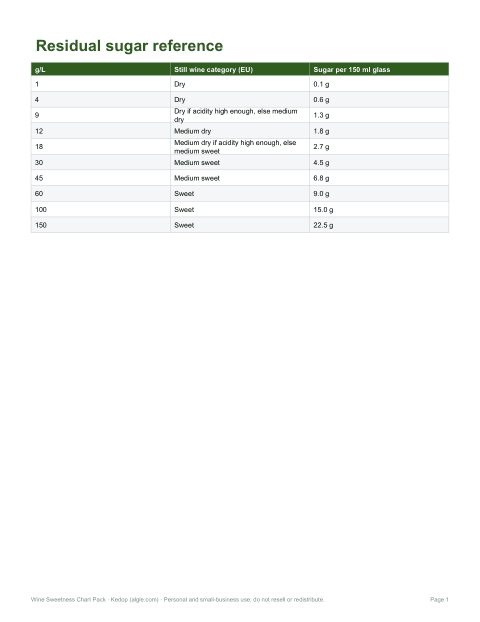
Still wine sweetness categories
| Label term | Residual sugar (EU) |
|---|---|
| Dry | ≤ 4 g/L (up to 9 g/L if acidity is high enough) |
| Medium dry (off-dry) | ≤ 12 g/L (up to 18 g/L with high acidity) |
| Medium sweet (semi-sweet) | ≤ 45 g/L |
| Sweet | ≥ 45 g/L; at 45, medium sweet is also permitted |
Under EU labelling rules, a still wine may be called dry up to 4 g/L of sugar, or up to 9 g/L if its total acidity (as tartaric acid) is no more than 2 g/L below the sugar; similar acidity allowances apply to medium dry. Many dry wines have only 1–2 g/L of sugar.
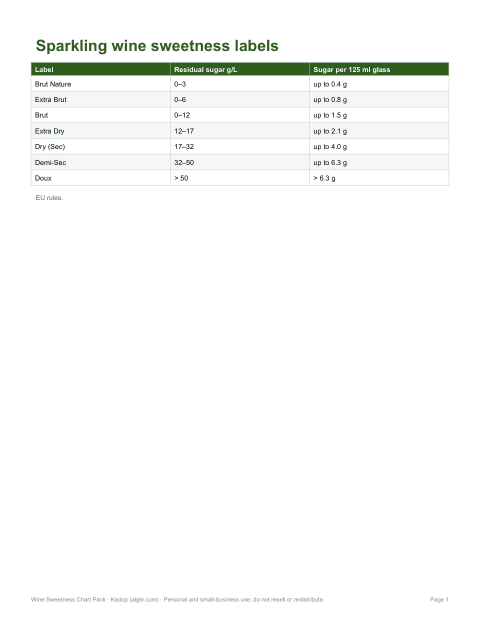
Sparkling wine labels
| Label | Residual sugar (g/L) |
|---|---|
| Brut Nature | less than 3 (no sugar added after secondary fermentation) |
| Extra Brut | 0–6 |
| Brut | less than 12 |
| Extra Dry | 12–17 |
| Dry (Sec) | 17–32 |
| Demi-Sec | 32–50 |
| Doux | more than 50 |
The names are confusing: “Extra Dry” is sweeter than Brut, and “Dry” or “Sec” sparkling wine is noticeably sweet. Brut is by far the most common style of Champagne and many other traditional-method sparkling wines.
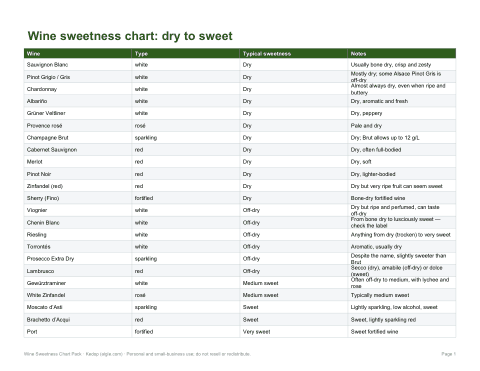
Popular wines from dry to sweet
| Wine | Type | Typical sweetness | Notes |
|---|---|---|---|
| Sauvignon Blanc | white | Dry | Usually bone dry, crisp and zesty |
| Pinot Grigio / Gris | white | Dry | Mostly dry; some Alsace Pinot Gris is off-dry |
| Chardonnay | white | Dry | Almost always dry, even when ripe and buttery |
| Albariño | white | Dry | Dry, aromatic and fresh |
| Grüner Veltliner | white | Dry | Dry, peppery |
| Viognier | white | Off-dry | Dry but ripe and perfumed, can taste off-dry |
| Chenin Blanc | white | Off-dry | From bone dry to lusciously sweet — check the label |
| Riesling | white | Off-dry | Anything from dry (trocken) to very sweet |
| Gewürztraminer | white | Medium sweet | Often off-dry to medium, with lychee and rose |
| Torrontés | white | Off-dry | Aromatic, usually dry |
| White Zinfandel | rosé | Medium sweet | Typically medium sweet |
| Provence rosé | rosé | Dry | Pale and dry |
| Moscato d’Asti | sparkling | Sweet | Lightly sparkling, low alcohol, sweet |
| Champagne Brut | sparkling | Dry | Dry; Brut allows up to 12 g/L |
| Prosecco Extra Dry | sparkling | Off-dry | Despite the name, slightly sweeter than Brut |
| Cabernet Sauvignon | red | Dry | Dry, often full-bodied |
| Merlot | red | Dry | Dry, soft |
| Pinot Noir | red | Dry | Dry, lighter-bodied |
| Zinfandel (red) | red | Dry | Dry but very ripe fruit can seem sweet |
| Lambrusco | red | Off-dry | Secco (dry), amabile (off-dry) or dolce (sweet) |
| Brachetto d’Acqui | red | Sweet | Sweet, lightly sparkling red |
| Port | fortified | Very sweet | Sweet fortified wine |
| Sherry (Fino) | fortified | Dry | Bone-dry fortified wine |
| Sherry (Cream / PX) | fortified | Very sweet | Very sweet |
| Sauternes | dessert | Very sweet | Sweet, botrytised white |
| Tokaji Aszú | dessert | Very sweet | Sweet, botrytised Hungarian white |
| Ice wine / Eiswein | dessert | Very sweet | Very sweet, from frozen grapes |
Typical styles only — producers vary, and grapes like Riesling and Chenin Blanc are made at every sweetness level. Check the back label or the producer’s technical sheet for residual sugar.
Why some sweet wines taste dry
Acidity balances sweetness. A German Riesling with 18 g/L of sugar and 9 g/L of acidity can taste only off-dry, while a low-acid wine with 8 g/L may seem noticeably sweet. The International Riesling Foundation taste profile also considers pH. This tool shows only the sugar-to-acid ratio; it does not implement that taste profile. Ripe fruit flavours, oak and higher alcohol can also make a dry wine seem sweeter; tannin makes red wines feel drier.
Worked example
A shopper sees a Riesling whose tech sheet lists 18 g/L residual sugar and 8.5 g/L total acidity. In the converter, the EU category is medium dry — the sugar is above 12 g/L, but within the 18 g/L allowance because the acidity is high enough — and the sugar-to-acid ratio is about 2.1. That ratio alone does not establish how sweet the wine tastes. A 150 ml glass contains about 2.7 g of sugar. They choose it to pair with a spicy Thai curry, where a touch of sweetness tames the heat.
Pairing by sweetness
- The wine should be at least as sweet as the food — otherwise it tastes sour and thin.
- Off-dry whites suit spicy dishes.
- Dry, high-acid whites suit salty and fried foods.
- Sweet wines suit blue cheese and fruit desserts.
- Dry reds usually clash with sweet desserts; try port or a sweet sparkling red instead.
AI-assisted content
This chart was drafted with AI assistance and reviewed before publishing. Sugar levels are typical ranges and legal definitions summarised from EU rules; always check the individual wine’s label. Please drink responsibly.
Reference scope
EU nominal categories follow Annex III of Regulation 2019/33, consolidated 18 January 2025. At 45 g/L, medium sweet and sweet overlap. Total acidity is expressed as tartaric acid. Where terms overlap, the producer selects one; labelling tolerances and product-specific provisions are not modelled.
Frequently asked questions
Which wines are the sweetest?
Dessert wines such as Sauternes, Tokaji, ice wine, port and cream sherry.
Is Prosecco sweet?
Brut Prosecco is dry; Extra Dry and Dry versions are slightly to noticeably sweeter.
Is Riesling sweet?
It can be anything from dry to very sweet — look for trocken (dry) or the label’s sweetness scale.
Are red wines sweet?
Most are dry; exceptions include Lambrusco amabile/dolce, Brachetto and port.
What does residual sugar mean?
Grape sugar left in the wine after fermentation, in grams per litre.
Is this a subscription?
No, the pack is a one-time download.